0 мин
Johns Hopkins University was founded in 1876. It is renowned for its cutting-edge research in medicine and life sciences, strong programs in engineering, public health, and international relations. It is recognized as one of the best in the world for the number of scientific discoveries and the implementation of innovative solutions in medicine and technology.
| Degree of study | Bachelor's, Master's, Doctoral, MBA |
| Percentage of students accepted | 7% |
| Probability of employment after training | About 94% of graduates find employment or continue their education within 3-6 months after graduation. |
| Scholarship | Wide range of scholarships and financial aid for students |
| Directions | A multidisciplinary university with a wide range of programs |
| Type | Private University |
| Student body size | About 24,000 students |
| % of international students | About 15% |
| Student town | The campus is located in Baltimore, Maryland. Students have easy access to the city's cultural life, including museums, theaters, restaurants, and other cultural events. |
| Selectivity | Very high level of selectivity |
Johns Hopkins University has a wide range of departments and schools that span academic and professional fields, from the natural sciences to business and advanced international studies.
Studies literature, history, philosophy, music and art. Major programs: History, English Literature, Philosophy, Music Theory and Composition.
Explores economic, political and social processes. Main programs: Political Science, Sociology, Economics, International Relations, Behavioral Sciences.
Focuses on the study of physical and biological phenomena. Major programs: Biology, Chemistry, Physics, Mathematics, Earth and Environmental Sciences.
Offers training in engineering and technology fields. Main programs: Biomedical Engineering, Chemical Engineering, Mechanical Engineering, Electrical and Computer Engineering.
Provides higher medical education and research in the field of medicine. Main programs: Doctor of Medicine (M.D.), Biomedical Sciences, Neuroscience.
Engaged in the study and prevention of public diseases. Main programs: Public Health, Epidemiology, Global Health.
Focuses on international relations, diplomacy and global politics. Major programs: International Relations, International Economics, Conflict Resolution.
Specializes in music education and performing arts. Main programs: Music Performance, Music Technology, History of Music.
Provides training for specialists in the field of education and pedagogy. Main programs: Education, Education Management, Special Education.
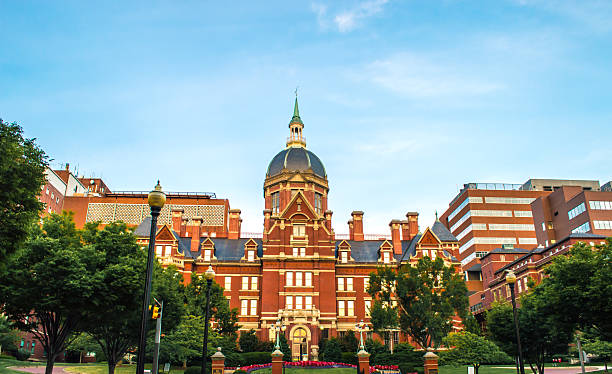
The Johns Hopkins University campus is located in Baltimore, Maryland, and occupies a large area that includes both modern and historic buildings. The campus is famous for its academic buildings, green parks, and paved walkways, creating a unique atmosphere for studying and relaxing.
Johns Hopkins University offers several undergraduate residence halls, including:
Each residence hall offers students single or shared rooms, shared kitchens, and lounge areas. Students can take advantage of laundry facilities, study areas, internet access, and organized activities to create a student community.
Both on-campus and off-campus housing options are available for graduate and doctoral students, including:
These apartment complexes offer private apartments or rooms with common areas, providing comfortable and convenient living for older students and their families.
The Johns Hopkins campus is guarded 24 hours a day, with security cameras, emergency phones, and regular patrols.
Students have access to libraries, computer centers, student centers, and gyms, making campus life comfortable and fulfilling. Resident assistants and coordinators help students with housing issues and actively engage them in social activities.
Applications are submitted through the Common Application, Scoir, and Coalition platforms. Admission is extremely competitive: up to 7% of all applicants are accepted to the university. This means that the university carefully selects the best candidates, taking into account their academic and extracurricular achievements.
Documents:
Students can apply for Early Decision until November 1 or for Regular Decision until January 2.
The deadline for applications is January 2.
Early round results are announced in mid-December, regular round results in early May. The final decision is announced in early May. Accepted students must confirm their admission by June 1.
The Johns Hopkins University curriculum focuses on innovation and interdisciplinary approaches. Students have the flexibility to shape their curriculum by choosing courses that match their academic interests and career goals. The university offers a variety of learning formats: lectures, seminars, labs, and research projects, which promotes deep study of disciplines and the development of independent research skills.
Bachelor’s degree: $63,340 per year.
Master’s degree: $65,956 per year.
Doctorate: $65,000 per year.
The tuition fees at Johns Hopkins University are high, but they can be fully or partially covered by scholarships and grants. They are awarded on the basis of financial need (need-based) and for research achievements. The university does not provide academic scholarships (Merit-based scholarships).
Available to students who need financial support to cover tuition and living expenses.
To receive need-based scholarships, students must complete financial aid applications, providing information about their family income and other financial obligations.
The University uses a comprehensive approach to assess the needs of each student and offers financial aid packages that may include grants, scholarships, student loans, and on-campus work opportunities.
Important! The University adheres to a “need-blind” policy, which means that a student’s financial situation does not affect the admissions decision.
These grants are designed to support students in pursuing their research ideas and projects. They cover equipment, materials, travel to conferences, and other research-related expenses.
To receive a research grant, students must submit an application describing their research project, its objectives, and expected results.
Typically, they are also required to provide recommendations from faculty and project supervisors, as well as evidence of previous research achievements.
To receive a scholarship, a student must complete the following steps:
Check out the terms and requirements of each scholarship on the official Harvard website.
Gather necessary documents, including academic records, recommendations, test scores, and financial information.
Check out the terms and requirements of each scholarship on the official Harvard website.
In some cases, especially for research fellowships, you will need to undergo an interview or discussion.
After submitting your application, you just have to wait for the results, which are usually announced at the same time as the admission decision.
University graduates are in demand in large companies, government and research organizations, which helps them quickly find work and build a career. Graduates can also get support from the university’s career center, using consultations, trainings and visiting job fairs.
Johns Hopkins University collaborates with leading companies and organizations, opening up broad career opportunities for graduates. Partners include Google, Microsoft, Amazon, Goldman Sachs, Pfizer, as well as international organizations, including the UN and the World Bank.
Johns Hopkins University helps students find internships and practicums. Students receive support in resume preparation, interviews, and finding opportunities. Internships are available in medicine, business, engineering, and other fields, including paid summer programs at partner companies and research institutions.
Johns Hopkins University actively supports its alumni at all stages of their careers. The alumni association and network help establish professional connections, participate in events, webinars, and career fairs. The university also continues to provide career counseling, promoting professional development, and maintaining connections to the community.
Johns Hopkins University was the first research university in the United States.
Its creation was initiated by philanthropist Johns Hopkins, who donated $7 million to establish the university and hospital. This donation was the largest in U.S. history at the time.
Johns Hopkins University pioneered the idea of learning through inquiry in higher education.
This model radically changed the approach to academic work in the United States and had a major impact on the development of American universities.
Founded in 1893, Johns Hopkins University School of Medicine is known for its innovative medical and teaching methods.
It was the first in the United States to require applicants to have a college degree and basic science training, setting a new standard for medical education.
Lighting of the Quads Ceremony
In December, students and faculty gather for a festive ceremony where thousands of lights around campus are lit. This event symbolizes the arrival of the winter holidays and brings the university community together in a warm and festive atmosphere.
Fountain Hopping
This is an unofficial but popular tradition among students. During the spring semester, especially before graduation, many students take a series of “jumps” into campus fountains to symbolize the joy and freedom of college life.
Johns Hopkins Day
An annual event honoring the founder of the university. The day includes a variety of academic and cultural events that honor the legacy of Johns Hopkins and its contributions to education and health care.